

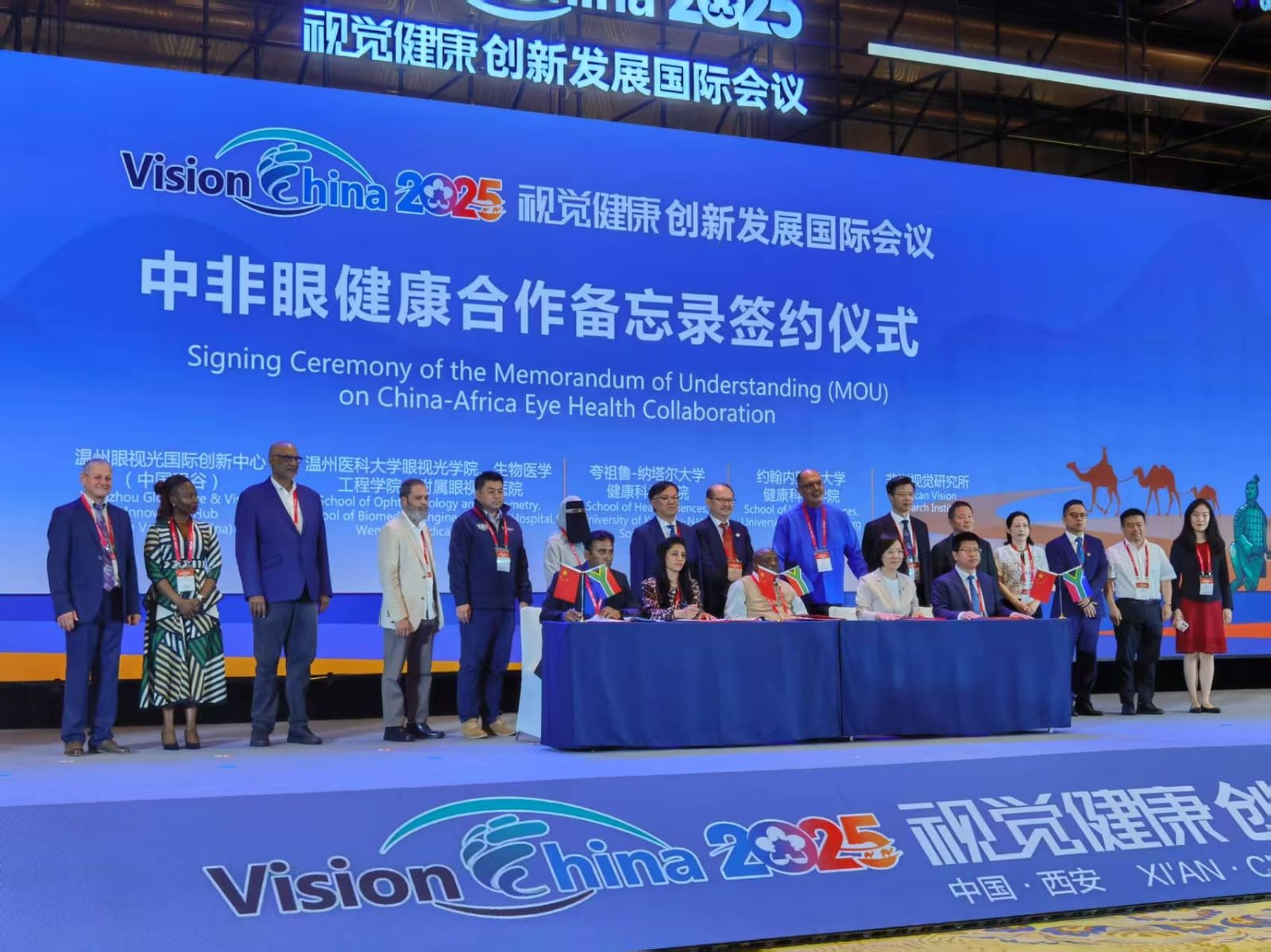
A visionary partnership between the University of KwaZulu-Natal (UKZN) and Wenzhou Medical University has taken a significant step forward with the formalisation of the China-Africa Eye Health Collaboration — a landmark initiative aimed at advancing eye health, education, and research across the African continent.
This collaboration follows a series of strategic engagements between the two institutions, reflecting a shared commitment to global health equity and sustainable development in vision care. In early 2025, a high-level delegation from Wenzhou Medical University visited UKZN to deepen discussions and explore collaborative opportunities. This reciprocal relationship culminated in June, when a UKZN delegation travelled to Xi’an, China, to participate in the Signing Ceremony of the Memorandum of Understanding (MoU) on China-Africa Eye Health Cooperation.
The UKZN delegation comprised leading academics and healthcare experts Professor Khathutshelo Percy Mashige, Dean and Head of the School of Health Sciences and Chief Executive Officer of the African Vision Research Institute (AVRI); Professor Kovin Naidoo, Honorary Professor in Optometry at UKZN and Executive Member of AVRI; Dr Nombuso Mathe, Head of the Department of Ophthalmology amd Dr Naimah Ebrahim Khan, Academic Leader of the Discipline of Optometry.
The MoU was signed as part of the prestigious Vision China 2025 International Conference on Eye Health Innovation and Development, held in Xi’an. This global event brought together policy-makers, researchers, clinicians, and industry leaders to foster innovation and cooperation in eye health worldwide.
Spearheaded by the African Vision Research Institute (AVRI)—a centre of excellence based within UKZN’s Discipline of Optometry—the China-Africa Eye Health Collaboration is designed to address the pressing challenges in eye health systems across Africa. It aims to:
- Promote bilateral academic exchange and collaborative research
- Enhance training and capacity building for eye care professionals
- Support the adoption of innovative technologies in clinical practice and education
- Increase access to affordable, high-quality eye care services in underserved communities
This initiative is particularly timely given the increasing burden of preventable visual impairment and uncorrected refractive errors across the continent. The partnership will draw on the clinical, academic, and technological strengths of both institutions to co-develop solutions tailored to the African context, while also contributing to global knowledge in vision science.
In his remarks at the signing ceremony, Mashige emphasised the significance of the collaboration: “This partnership is more than a symbolic agreement—it is a strategic alliance rooted in mutual respect and a shared vision for improving eye health outcomes. Together, we are building a future where knowledge, resources, and innovation are shared to benefit all.”
Naidoo, a global leader in public health optometry, noted the importance of advancing Africa’s eye health agenda through global partnerships. He highlighted that the collaboration is in alignment with broader international initiatives, such as the World Health Organization’s SPECS 2030, which calls for integrated, people-centred eye care services.
Ebrahim Khan added that academic collaborations such as this have the potential to transform education, enhance clinical training, and shape a new generation of African optometrists equipped to meet the continent’s evolving needs:
“I am grateful for the opportunity to be part of such a meaningful exchange. The conversations, ideas, and partnerships forged here will ripple across borders and disciplines, strengthening the future of eye health in Africa.”
Mathe also echoed these sentiments, noting that interdisciplinary and international cooperation is essential to addressing the complex challenges facing ophthalmic care and eye health workforce development in low-resource settings.
The China-Africa Eye Health Collaboration represents UKZN’s unwavering commitment to driving excellence in teaching, research, and service, while contributing to regional and global health priorities. It also strengthens UKZN’s growing footprint in international academic networks and highlights its leadership in forging partnerships that have real-world impact.
This milestone marks the beginning of a transformative journey that will elevate African optometry and ophthalmology, enrich academic scholarship, and most importantly, improve the lives of millions across the continent through better vision and eye health.